 Loading up a glaze kiln of yellow, pink, purple, blue and green cups today. I use two resists to mask off the drawings from the first glaze spray (blue tape and contact paper). The blue shapes made by the tape are pretty interesting. These cups feature more playing characters. Pictures of finished work to come.
Friday, May 27, 2011
Cups in Process
Loading up a glaze kiln of yellow, pink, purple, blue and green cups today. I use two resists to mask off the drawings from the first glaze spray (blue tape and contact paper). The blue shapes made by the tape are pretty interesting. These cups feature more playing characters. Pictures of finished work to come.

Sunday, May 22, 2011
Playscapes Blog
 For me, "play" and "research" are not necessarily mutually exclusive terms. Especially, when the "research" involves lots of exciting ideas and gorgeous pictures or a chance to ride a roller coaster, like I have planned to do tomorrow when I visit Busch Gardens. Aahhh, research.
When the research happens at the computer, Paige Johnson's playscapes blog is a regular stopping point for generating ideas and connecting with playground design from many lands and eras. It's great for anyone interested in the landscapes of play.
Because a playground doesn't have to cost a million bucks and come in a box. In fact, it's better if it doesn't.
Because playgrounds are under-recognized as an artistic medium.
Because everybody loves a playground. 
Arcady, aka Paige Johnson, writes of her blog, "Playscapes":
Because it's difficult to find non-commercial playground information. And I find that frustrating.
Because a playground doesn't have to cost a million bucks and come in a box. In fact, it's better if it doesn't.
Because playgrounds are under-recognized as an artistic medium.
Because everybody loves a playground.
Saturday, May 21, 2011
Playscaping

My studio research has focused on play for the past few years. How does play influence personal identity? How is play portrayed in Art? In what environments do we allow ourselves to play? What do our toys look like? (And what do they teach us?) Who is allowed to play? Can we transcend our realities through play?
The word, "playscape" has multiple associations for me. First, it refers to the environments in which we play. I am interested in what these landscapes of leisure look like and how space is divided within these landscapes.
The transcendent potential play provides leads to the second association of the word, "playscape." I think about how play allows us to escape or 'scape present realities, or troubles.
For my most recent exhibition, I developed a series of plates that featured imaginary creatures, each with a physical limitation, such as limited mobility due to aging, being overweight, missing a limb, etc. I attempted to show these creatures in a state of play, overcoming their current reality.


Tuesday, May 17, 2011
Cup Forms


I spent a lot of time this past year obsessing about my handled cup form. I made several grossly unsuccessful (and frankly un-sellable) attempts at reinventing the cup, in an attempt to have it speak the same language as my other pottery forms. Anyone who peeked into my studio looking for cups, surely walked out with wrinkled eyebrows, scratching their heads. I am going to spare you the cups that didn't make it to sale status, and instead post the two cup-forms I feel most successful about. The first, a cup and saucer, features a beaded handle that is tedious to make, but surprisingly comfortable for the one-finger grip. I have a passion for form and design and enjoy bringing a touch of the unexpected to functional ceramics.
The second form is a very simple, generic form that lends itself to illustrated surfaces. The contours of this cup shift smoothly from one angle to the next, meaning no surface of this cup is unavailable to an illustration. In fact, what I enjoy most about this form is being able to wrap the drawing around the bottom. The stories illustrated are of creatures engaging in some sort of play activity: roller skating, dancing, jumping on a trampoline, playing with a ball. I love that the illustration is not fully visible to a spectator until the cup’s user drinks the last drops of liquid from the cup, fully exposing the bottom and the entire picture.


Saturday, April 23, 2011
Number Five
 Richard Notkin recently presented a workshop at Florida Atlantic University. First, Notkin gave all of the workshop attendees one cubic inch of clay and told us to work with it for one hour. We could use any tools that we wanted. We did not have to use all of the clay, but we were told to stay quiet and work for the entire 60 minutes.
I worked on a small bunny sculpture; later turning it into the salt and pepper set you see here.
Notkin talked about Time as an element in art-making. Giving each of us a small amount of clay, a few guidelines, and the uninterrupted time to give the clay the care and attention it deserved proved to be a valuable gift. After all, our lives are defined by time.
As a resident artist and ceramics teacher, I do have lots of studio time. However, my To-Do Lists are always looming, and interruptions are frequent. The quality of time is not what it should be. Through Notkin's exercise, I learned that 60 minutes/week of guilt-free, studio play-time needs to be an essential part of my artistic practice.
#5 S& P ended up being in the resident artist exhibition at the Armory Art Center. My body of work for the exhibition centers on themes of play. The illustrations and figurative pieces, specifically, are about transcending one's present reality through the act of play. I am in the process of documenting the work in the show. Look for a blog post about it soon.
Friday, March 11, 2011
Gettin' Smaller
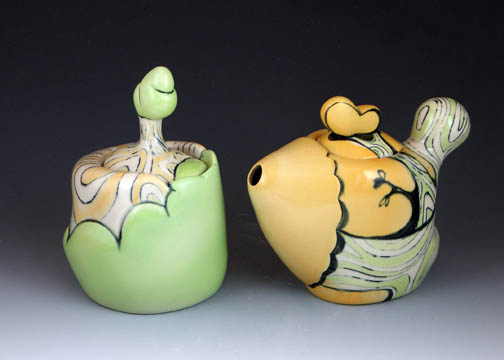
These are on display at the Armory Art Center foyer, as a part of a ceramics and sculpture faculty exhibit. The creamer and sugar jar are little guys: approx 5 inches tall. I am working toward my piece for Small Favors at the Clay Studio in Philly, which needs to be no larger than 3.75 inches. Get out your magnifying glasses!
Wednesday, March 2, 2011
Mad Hats and Paint Chips
 The Armory Art Center's Mad Hatter Luncheon is tomorrow. The annual event raises money for the resident artist program. Traditionally, attendees wear wild and wacky hats to the luncheon. The hats range from handmade to high-design.
I was inspired by the paint chip art I saw at Art Basel in Miami this year. A google search of "paint chip art" will yield a healthy return for your visual pleasure.
There are many things I loved about this project: the flat colors, the petal configuration, the ease of hot glue, and especially the low cost of the materials. Can't get much cheaper than free, now can I?
I built this hat just like I would if I was coiling a pot: I put the hat on a banding wheel and engaged in the rhythm of glue, press, turn, glue, press, turn.

I also made a fancy broach out of paint chips to wear with my dress tomorrow. Hope it does
not rain!
Subscribe to:
Posts (Atom)